Showing posts with label Timeline. Show all posts

Friday, December 2, 2011

Fashion History Dolls 4

The last group!

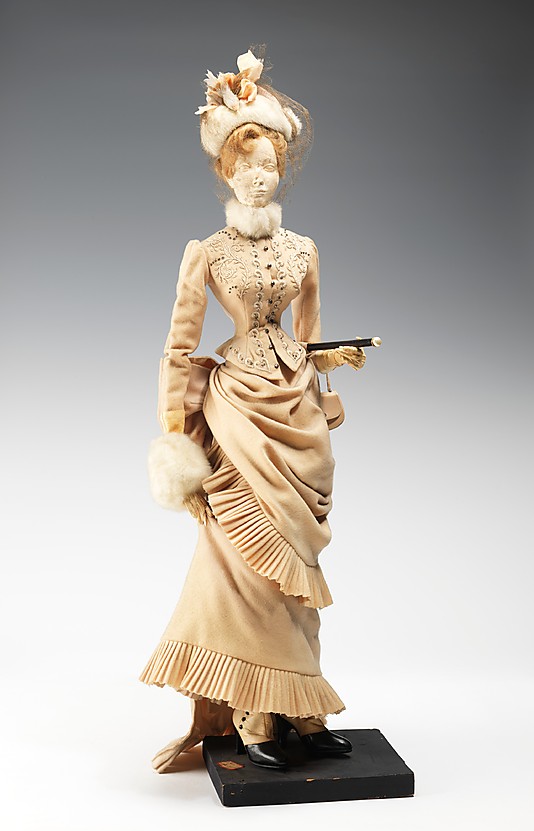
1888: House of Balmain. "The inspiration for this dress was a design created by Worth for the Empress Elizabeth of Austria. Empress Elisabeth of Austria (1837-1898) was the wife of Emperor Franz Joseph (1830-1916). She was known for her keen fashion sense as well as strict health and beauty regimen."


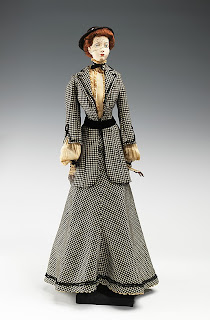
1890: Georgette Renal. "This dress was inspired by a design by Redfern. British-born designer John Redfern opened his salon in the English seaport town of Cowes. As the house's popularity grew in Britain, it was expanded to the United States, and later Paris in 1891 under the design direction of John Poynter. After years of success Redfern was "By Royal Appointment to Her Majesty the Queen and H.R.H. The Princess of Wales" in 1888. After Redfern's death the house continued under the direction of Poynter, becoming a member of the Chambre Syndicale de la Haute Couture."

1892: Germain Lecomte. "The inspiration for this dress came from a painting by Leon Bonnat (1833-1922)."


1896: Bruyere. "Though the exact garment is not known, the inspiration for this dress came from a design by Jacques Doucet (1853-1929)."


So, which one is your favorite?  I'm rather in love with 1902, but I do also like 1867, 1788, and 1762.

Tuesday, November 29, 2011

Fashion History Dolls 3

1855: Véra Boréa. "The unique style of this dress, representing the year 1855, was taken from one launched by Empress Eugénie during her trips to the Pyrenees Mountains. The skirt is lopped up by tabs from the underskirt. The shoes are particular highlights of this ensemble, featuring incredible care and 
minute detail."


1866: Marcelle Chaumont. "The inspiration for this doll came from a painting by Winterhalter. Franz Xaver Winterhalter (1805-1873) was a German painter best-known for his royal portraiture. His most well-known works include portraits of Empress Eugénie and Empress Elisabeth of Austria."


1870: House of Balenciaga. "Balenciaga's doll was inspired by a dress made for Princess Metternich. Princess Metternich was a great patron of the arts, and responsible for introducing Charles Fredrick Worth to the Empress Eugénie, his greatest client."


1878: House of Lanvin. "The house of Lanvin was inspired by the paintings of Sir Lawrence Alma-Tadema when designing her contribution to the Gratitude Train. Alma-Tadema (1836-1912), was a Dutch-born painter who later settled in England was one of the most renowned artists of late 19th-century. He painted classical subjects, most often scenes of the luxurious Roman Empire. Known for his meticulous research, Alma-Tadema's paintings were used in the 20th century as source material for several Hollywood movies including, "Ben Hur", "Cleopatra", "The Ten Commandments", and "Gladiator". Though Lanvin's doll represented the year 1878, the classical draping and brilliant colors of Alma-Tadema's work are evident in the design."


Sunday, November 27, 2011

Fashion History Dolls 2

The next 10 Dolls:
1791: Martial & Armand. "Martial & Armand, a long-standing and reliable, if minor part of Paris couture designed this dress after an engraving by Boilly. Léopold Boilly (1761-1845) was a French genre painter and engraver, known for his depictions of Parisian life and culture."


1800: Raphael. "The doll by Raphaël represents the Merveilleuse style of the early 19th century. The Merveilleuse were the female counterpoint to the Incroyables, royalist sympathizers noted for their exaggerated style à la Grecque and anti-revolutionary ideals. Thérésa Tallien was at the forefront of this movement, becoming a fashion leader, along with Josephine de Beauharnais, of the French Directory. Tallien's personal style was the model for the age. She famously arrived at the Paris Opera once wearing a sleeveless silk dress with no underwear. Though the masses did not adopt the extremity of Madame Tallien's style, the paper-thin gowns with flesh-colored knitted undergarments were surely in imitation of 
her daring."

1808: Madame Gres. "The 1808 gown is an interpretation of the style à la Grecque as worn by Empress Josephine, the main fashion originator of the period along with Thérésa Tallien. The design is taken from one made by Leroy, couturier to the Empress. Hippolyte Leroy was the tailor to Empress Josephine responsible for creating the empire gowns she was famous for. This version of the gown was appropriately created by Madame Grès, famous for her love of the Grecian style and draping techniques."


1832: Marcelle Dormoy. "Marcelle Dormoy's creation for the Gratitude Train was designed after a dress by Mlle. Palmyre, whose salon served the ruling class, including Queen Marie-Amélie and Empress Eugénie. The quality of construction is particularly fine and evident in the pantaloons of this doll"


Saturday, November 26, 2011

Fashion History Dolls 1

I came across a set of these dolls while searching for dresses on the Met Museum's site.  While I can't say they're perfectly accurate, they do all have research put into them and evoke their periods well.  Here's what the museum says about them:
"In 1947, in response to the suffering of post-World War II France, an American grassroots campaign organized a large-scale relief package. The following year France, moved by this generosity, organized a gift in kind. As the aide was sent to France housed in boxcars and dubbed the "American Friendship Train" the French created the "Gratitude" or "Merci Train", a set of 49 boxcars filled with gifts of thanks. Each of the 48 states was to receive a boxcar with the 49th shared between Washington D.C., and the Territory of Hawaii, which had contributed sugar on the Friendship Train. A wide array of items was included in these cars, from handmade children's toys to priceless works of art. 

The Chambre Syndicale de la Couture de Parisienne, who, to raise money for the French people, had two years prior organized the Theatre de la Mode, a group of fashion dolls dressed in clothing from the 1947 couture collections, chose to create a new set of fashion dolls, this time representing the evolution of French fashion rather than the current season. Once again, the Syndicat tapped the most talented and well-known fashion designers, hairstylists, and accessory designers of the time to create these miniature masterpieces.

The unique design of the fashion doll, originally created for Theatre de la Mode and used again for the Gratitude Train was conceived by Eileen Bonabel, the plaster head by the artist Rebull. Each doll measures approximately 24 inches tall, with bodies made entirely of open wire. Human hair was used to fashion the hairstyles. Each designer chose a year between 1715 and 1906 for which to dress his doll. Their varying sources of inspiration included works of art, literature, and historic fashion plates. The Gratitude Train fashion dolls represent a unique moment in the history of couture as they represent not only creative interpretations of historic fashions by the greatest designers of the period, but also are infused with the unparalleled skill, care, and attention to detail that would have been applied in their full-size counterparts.
 "


I'm posting about the first 10 today, there are 43 overall.
1715: Marcel Rochas. "The inspiration for this dress came from the painting L'Enseigne de Gersaint by Watteau. Antoine Watteau (1684-1721) was best known for inventing the fete galante, a genre characterized by outdoor parties and bucolic scenes in idyllic settings. L'Enseigne de Gersaint was actually completed in 1720, five years after the date of the Rochas design. Watteau created this work for his friend and art dealer, Gersaint's shop, where it is believed to have hung in the window as a sign. This painting, in addition to being an interesting study of everyday life in an art dealer's shop, is an excellent example of the famous "Watteau pleats". The fashionable women in Watteau's fete gallants were so often depicted wearing this style, that they became known as Watteau pleats."

1733: Jean Bader. "Jean Bader used a painting by Lancret for inspiration. Nicolas Lancret (1690-1743) was a French painter known for depicting scenes of light comedy and courtly life under the regent Orleans."

1755: A. Reichert. "This design by the furriers Blondell is credited as being a "Manon Lescaut" style. "Manon Lescaut", published by Antoine Françoise Prévost in 1731 typifies the lyrical emotion of rococo literature and inspired several stage productions including a ballets and operas by Massenet and Puccini."

1762: Edward Molyneux. "Molyneux's contribution features janseniste panniers, and was inspired by a portrait of Madame de Pompadour by de la Tour. Janseniste panniers were shorter and lighter-weight, stiffened with horsehair or boning and popular in the second half of the 18th-century. They were similar to English pocket panniers and allowed the wearer to access pockets in undergarments. Maurice Quentin de La Tour (1704-1788) was the French portrait artist to King Louis XV of France from 1750 to 1773. During his tenure, one of his many subjects was that of Madame de Pompadour (1721-1764), the famous courtesan and official mistress of Louis XV. "Madame Pompadour" (1755) depicts her in her home surrounded by books and works of art, alluding to her desire to enlighten the French court with the intellectual developments of Parisian culture at the time."

1774: Jean Desses. ""Les Adieux" by Jean-Michel Moreau le Jeune provided the inspiration for this dress by Jean Dessès. Moreau le Jeune (1741-1814) was a French illustrator and engraver best known for his illustrations recording fashionable dress and interiors in the "Monument de costume physique et morale" published by L.F. Prault in 1776-1783. The original etching and engraving is in the Metropolitan Museum of Art collection."

1779: Lucille Manguin. "Moreau le Jeune's painting "Le Rendez-vous" was the inspiration for the 1779 doll. Jean-Michel Moreau le Jeune (1741-1814) was a French illustrator and engraver best known for his illustrations recording fashionable dress and interiors in the "Monument de costume physique et morale" published by L.F. Prault in 1776-1783. The original etching and engraving is in the Metropolitan Museum of Art collection."

1785: Maggy Rouff. "Maggy Rouff designed this gown after a fashion plate from "La Galerie des Modes". "La Galerie des Modes" is credited as the first publication of fashion plates, printed by Parisians Jacques Esnauts and Michel Rapilly in 1778."

1787: Mendel. "Philibert-Louis Debucourt's painting "La Promenade au Palais Royal" was the inspiration for this doll by Mendel. Debucourt (1755-1832) was a French printmaker and social satirist known for his depictions of French society. "La Promenade au Palais Royal" caricatures the indulgent and frivolous nature of French society including prostitutes and other undesirables leading up to the French Revolution."

1788: Jacques Griffe. "Jacques Griffe's contribution to the Gratitude Train represents the year 1788. Griffe worked in the house of Vionnet where he perfected his draping and cutting techniques, developing a style similar to Vionnet in its mastery of bias and the human form. Griffe served France during World War II, even being taken prisoner before returning to Paris in 1941 to open his house . This dress was inspired by the polonaise costumes made popular by Marie Antoinette during her sojourns at the Trianon palace. The Petit Trianon is located on the grounds of the Palace of Versailles. The small chateau and surrounding park were given to Marie Antoinette as a gift from Louis XVI. There she enjoyed dressing in the style of the working class while escaping the pressure and intrusiveness of royal life."

Friday, July 15, 2011

1795-99

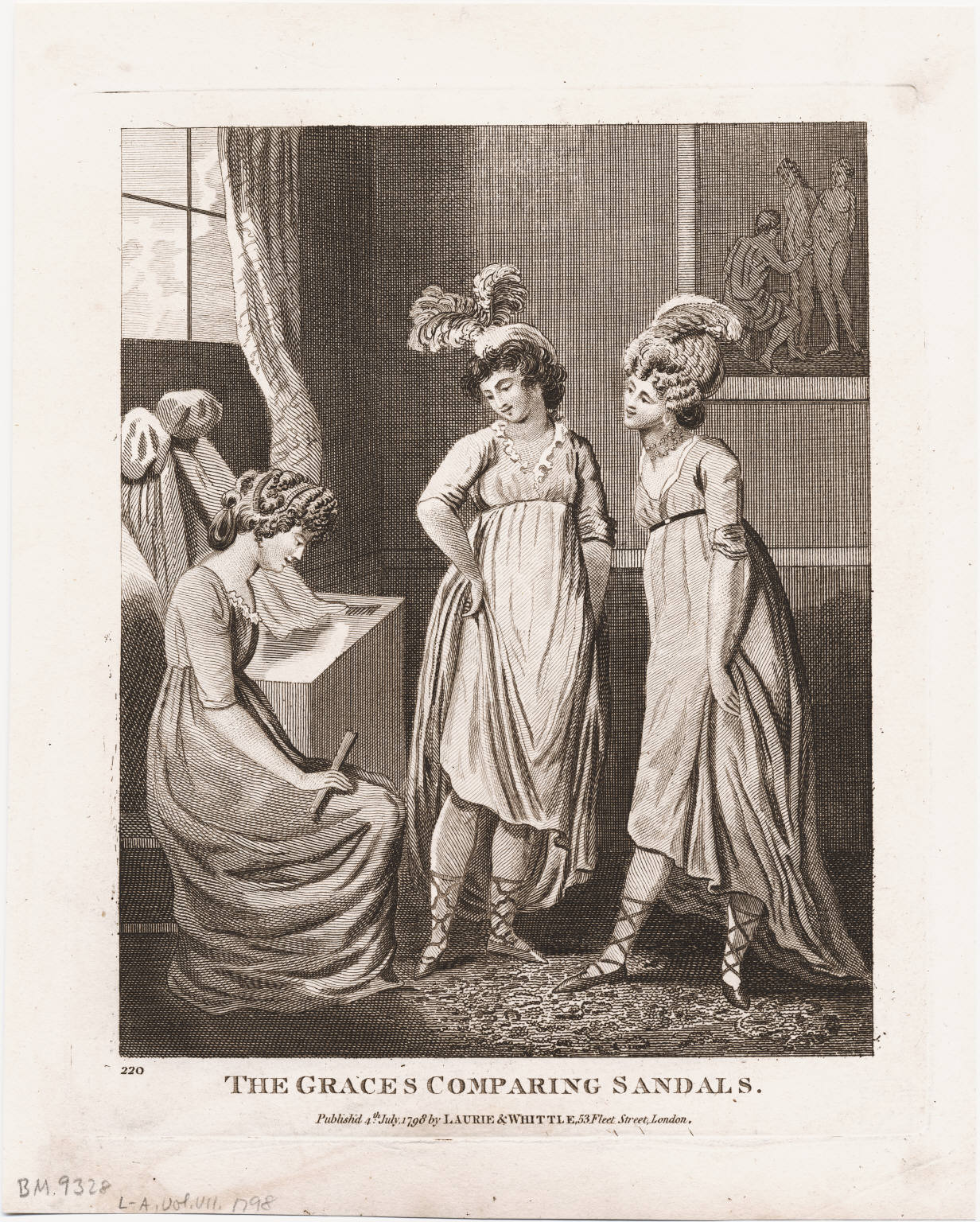
This seems to be a crazy time period.  After spending a great deal of time looking at just evening gowns to decide upon mine, there are so many options!  When else do you see so much asymmetry, sleeves a different color than the bodice, contrasting colors, and crazy feathers??  I can only assume this is what happens during a massive fashion shift where they haven't quite mastered designing with the new textiles yet, and still commonly use the old fabrics in silhouettes not quite suited.  Keep an eye out for varying sleeve styles, waist height, neckline shapes, and closures.
This is also the point where I'm going to stop categorizing everything the same way as before.  At least for this five year period, there are too many options.
Sleeves: Long, just above elbow, or short.  All fitted.
Bodice front: Gathered on cord, crossed, or low under bust.
Bodice back: Small diamond shape, some with numerous small pleats.
Skirt: Open and Closed.  Sometimes gathered in front.  Pleated in back, very small up to large box pleats.
Length: Trains common for evening and some afternoon.
Waist: Some natural waists still seen, most at underbust.
Fabrics: Cotton and silk most common.  Small repeated prints and solids.