Sunday, January 22, 2012

Second Pair

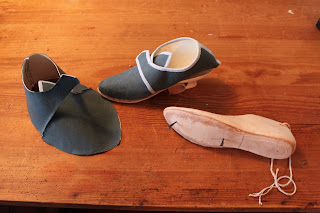
With another workshop held at my house this weekend, I've gotten a good start on my second pair of shoes.  I already had the outer soles ready and one of the uppers finished.

I covered the last and outer sole with paper, then lasted and tacked on the upper. We added in re-inforcement pieces to the toe area, unlike last time.  You can see the small marks of the stitches.  It's inserted between the leather and fabric, but only stitched to the leather.  All of that took most of day one.

A combination of a better sole leather, larger awl blade, smaller awl haft, and using 7-strand thread instead of 9 made this seaming go much faster and look much better than my first pair.  I still need to work on strengthening my grip in my left hand.  I think this inseaming took about 2 hours (someday, maybe it'll be 30 minutes; that would be glorious).

I also started carving down the heel to be the proper shape.  It's lost some length since this point.

With the stitching done, we removed the last from the uppers and started carving out the insole.  I still need to put a hold-fast in the heel area.

The upper was turned (not easy!), then I skived down the remaining flap of the outer sole so it would curve into the heel nicely.  I still need to finish binding the second upper before I can start on that shoe (it's such a pretty blue wool).  I have today off to recover then it's back to work on it tomorrow.  I'm hoping to have this pair done by mid-February.

Monday, January 16, 2012

Twelve Months

The 1912 gown is on hold until the chiffon swatches arrive (the first set didn't work) and the La Mode Illustrée pattern comes from France.  I've picked up an 1810s day dress in the mean time which will start to look like more than just pieces by tomorrow.  I took a break to wander through the British Museums prints and found a lovely set called The Twelve Months, dated to 1781.  Now, if I could just find 11 other people and an event this would make a great group costume idea!  The artist seems to have been a little color-happy, splitting garments into two or more tones when it doesn't make sense (has one ever seen a parti-color mantelet?).  Still, I'd wear every one of them.  Particularly August, who has given me inspiration for some pumpkin silk I have!

January looks quite toasty nestled in her pile of silks.

February is trying to stay warm and keep entertained.

March must be sewing together one of the next ensembles.

April showers bring out umbrellas and a plethora of colors!

May has hung up her mantelet and is ready for warmer weather.

June has taken a brisk ride through the country and still looks perfect.

July shows us how to protect our fair skin while still looking fashionable.

August doesn't give up being fashionable just because she's carrying a bucket of worms.

September is the time for harvesting grapes and vibrant colors.

October knows that fall is the perfect time for a fashionable riding habit.

November is taking a final stroll through the country before the weather turns cold.

December doesn't want to admit that the days are so short, staying up long after dark.

Friday, January 6, 2012

Vintage Dresses

I finally got around to taking pictures of a great many of my vintage dresses that I've made recently (ok, so some are two years old).  Posting just after all the pictures of my relatives in vintage dress made sense!   I'm planning on an entire 1930s wardrobe for a long Hawaiian cruise I'm taking this Spring, so be prepared for a lot more of this sort of thing.

Late '30s or early '40s in wool plaid. Simplicity 3162.

'30s in a poly suiting material.  I based it on Hollywood 832, though I couldn't afford the pattern!

 '30s in a sheer wool (the buckle is 19th century).  Butterick 7879.

'30s in very light printed cotton.  I don't know what pattern this is based on, but I found an image of a torn-up fashion book online that I liked!

Late '30s in some sort of Rayon or Poly.  A mail order pattern.

'30s in cotton seersucker.  Another mail-order pattern.

'40s in sheer rayon/poly.  A well-worn DuBarry pattern.

 My reception gown for my wedding.  Silver silk lamé with glass beads.  Inspired by Ginger Rogers gown in Roberta.  And yes, we did do a Astaire/Rogers style first dance.


 My wedding gown.  Stretch silk charmeuse with a silk velvet Spencer.  The buttons are death heads of course!  Based on a 1950s gown, but I think it evokes an earlier time as well.


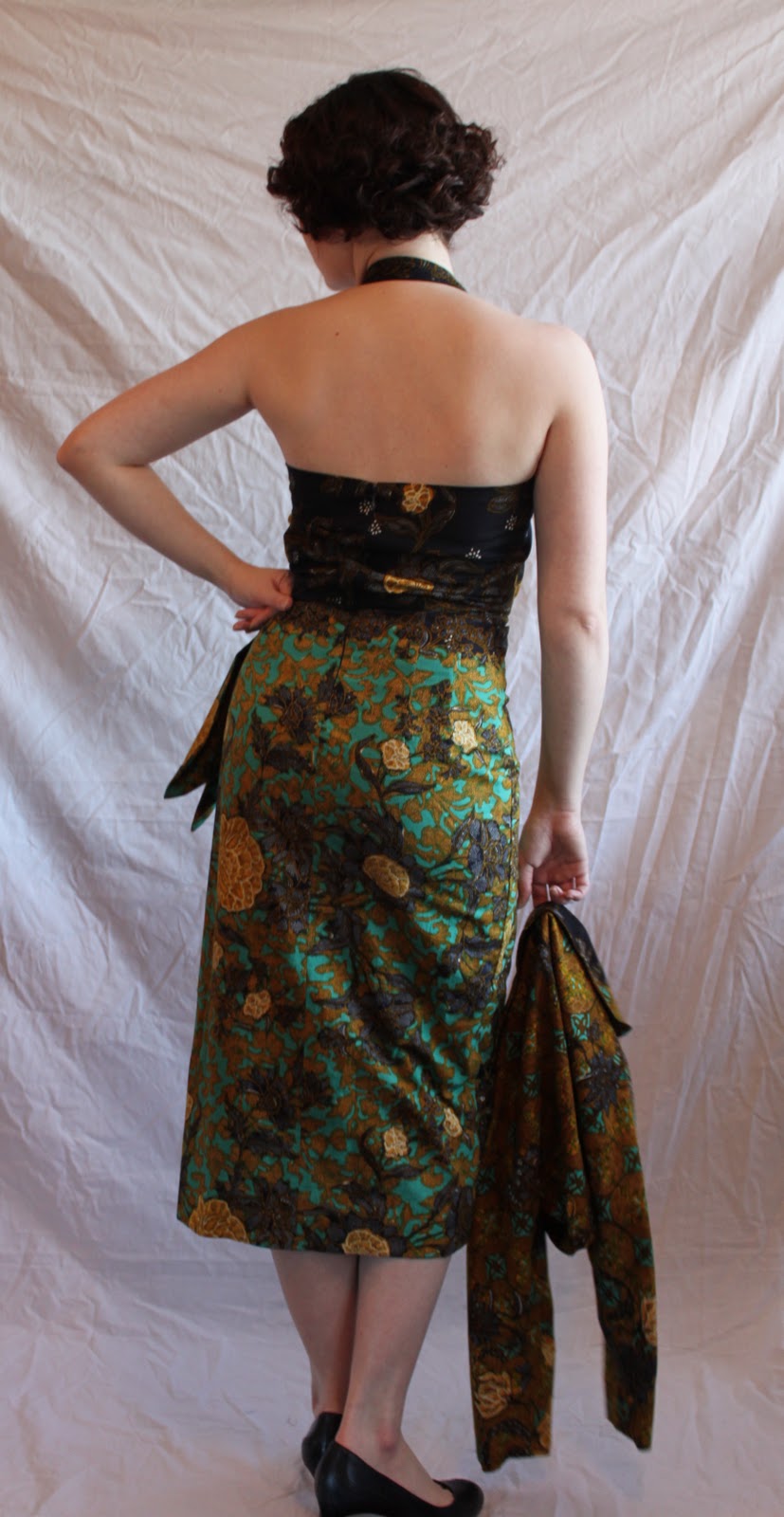
Our "rehearsal" dinner was at a Hawaiian restaurant, so I made up the classic '40s/'50s sarong dress from a cotton batik print.  Unfortunately it was below 50* out that night (record cold in Florida that winter).  I froze, but I still wore it!

Tuesday, January 3, 2012

Historic Body Shapes

Taking off of American Duchess's post about vintage body shapes, I was curious to see how my families general body shape has changed over the last 140 or so years.  I'm fortunate that my mothers side of the family were enthusiastic about having pictures taken, and saving them.  We always said that the female genetics on her side of the family were extremely strong (I look a great deal like my mother, who greatly resembles her mother, etc and my cousins all attest to the "Rothenberger booty" as we called it in highschool).  Genetically, my ancestors all seem to carry their weight in their hips.  I never thought much of it until I started gaining gradual weight since college; all in my hips.  But, it would be even more so the case if I wore a girdle or corset.  Honestly, a lot of the women in the pictures I have seem to have very similar body shapes and if it weren't for the corset/girdle/fashion style would probably be considered "fat" by modern standards.  I prefer the term "fleshy" myself (I always picture Marilyn Monroe in Some Like it Hot with that term).
Addendum: I changed the two questionable photographs.  I talked with my mother about them and she recognized a few things that meant it was actually my Grandmother's family (which we all thought we had no photographs of!). I still desperately wish I had a picture of my Great-great-grandmother from that side.  Turns out she was a gold-digger who married 5 times, divorced three of them!

Jennie (Carter) Heavilon [b. 1856].  My Great-great-grandmothers youngest sister.

Hannah (Carter) Zaring [b. 1837] and her two daughters Lucy [b. 1857] and Daisy [b. 1872]. My Great-great-grandmothers oldest sister and nieces.

Linnie Inez (Carter) Rothenberger [b. 1854].  My Great-great-grandmother.  11 children definitely means wide hips!

Sarah (Beisel) Ruch [b. 1858].  My Great-great-grandmother.


Edith Pearl (Rothenberger) Burkhalter [b. 1883] and Eva Henrietta (Ruch) Rothenberger [b. 1884]. My Great-grandfathers sister and my Great-grandmother.  Eva married into the family in 1903, so I'm guessing the picture is just after that.

Edith Pearl (Rothenberger) Burkhalter [b.1883].  Same person as above, just a few years and fashion change later.

Katie (Spencer) Keller [b. 1894]. My great-Grandmother holding my Grandmother.

Katie (Spencer) Keller again with my Grandmother and her sister Edith [b. 1902].

Katie (Spencer) Keller [b. 1894]. My Great-grandmother.

Maxine (Keller) Rothenberger.  My Grandmother [b.1918].

Irene (Rothenberger) Frazier [b. 1909] on left. My Great-aunt.

Ruch/Roscoe family event.  My Grandmother (Maxine) on right.

While some of these ladies could be considered "skinny" by modern standards without their foundations, all of those pictures place them at pre-child ages.  After that they all have more significant curves.  Oh, and note the feet of the lady on the left in the picture just above.  Those don't look tiny to me.  My mother said the Rothenberger/Ruch side always had big feet (I get my narrow feet from the Kellers and Shalkowskis).  My Grandmother has small feet, but she's always worn too small of shoes.  They were poor when she was little and she had to wear her buttoned up boots far longer than she should have.  Now, she's just accustomed to having tight shoes.

This just emphasizes why having the proper undergarments for the time AND for your body shape is so important.  You may not easily be able to train your waist and posture in to that lovely 1900s S-shape above, but that dress would look awfully baggy and wrinkly without a smooth corset.  As for body shape I have a 27" waist and a girdle from What Katie Did that I love to death.  It smoothes out that little bulge we all suck in in front with no effort and almost no discomfort.  I can't imagine a 1930s bias cut gown without it!

Saturday, December 31, 2011

1771 Dishabille

While looking for references to riding habits, I came across this little gem.  I know what the description sounds like to me, but I'd love to hear your opinions (I feel biased).  It's from the Kentish Gazette 28 September 1771.

Dear Madam,
My sister is so impatient for your account of fashionable articles, that she obliged me by this post to give you what she calls the sequel of my last letter. Thus then, in compliance with her orders, I enter upon my description of the dishabille recommended to us by on T----e, a mantua-maker.
The sleeves are close at the wrists, in the nature of your Brunswicks; but, instead of covering the neck, it is fitted to the make of it, and the turn of the shoulder; the back however has no plaits, but is taken in in the same way as a riding habit, and is likewise sloped on the sides, from which and the back it falls elegantly loose, and the slopes, by gradually increasing to the very bottom of the skirt, which is a tolerable length, supplies the whole fullness necessary to make it hang gracefully; it buttons down before with a kind of false stomacher, for the robe itself comes with a loose fold from the top of the sleeve, that forms the front breadths in like manner as the back; the petticoat is of the same and besides its having a very pretty, it has one very singular effect, that it improves the appearance of a fine woman, and conceals every defect in an ill made one: the mantua-maker assures us that it is a recent importation, and that none but a few families, and those of the first distinction, have yet seen it in England.....

Friday, December 30, 2011

Riding Drefs

While searching through the Lewis Walpole Gallery last summer I came across many images of riding habits, not all of which were the typical design we are accustom to seeing.  I started collecting up these to get a better idea of when or what it was.  Although there seems to be a variance of style (two in particular), I'm just going to define what follows as "unfitted Riding Habits", meaning they lack a waist seam.  It seems to come into style along with the Polonaise gown, and some distinctly resemble it down to the wrinkles.  Some are more military in style, one fashion plate of this style defines it as a Bavarian Frock, while the others have a tapering collar with a tie for closure in front.  There were many other images that looked like they might be unfitted, but I really couldn't tell if it was just the artists quick rendition (especially since the arm usually covers the seam).
I was in the Millinery/Tailor shop soon after and Mark Hutter had made a habit based on the Polonaise style (you can see the final product on Sarah here).  He mentioned that it might even be called Riding Habit a la Polonaise.  It took me up until this month to really delve into documents to find any references to that particular style.  I found three potential references to a Riding Habit a la Polonaise (or commonly Polonese), and a few good ideas of colors and interesting comments I'll post at the bottom.

In the Public Advertiser, April 15 of 1779: PARMENTIER, lately from Paris, Ladies Robe and Mantua-maker, makes all sorts of ladies dresses in the present taste; as Polish, Circassian, Italian, and Levee gowns for the country; Caraco a la Provencale, Riding-Habits a la Polonoise, and all sorts of corsets.

In the Morning Post and Daily Advertiser, January 31 of 1775 there is a Habit-Maker advertising that he makes "Masquerade dresses, and a la Polonaise".  I can't quite guarantee he isn't referring to a gown of that style, but it's something to keep in mind once I know more about who made Polonaise gowns (probably dependent on usage since "Polonaise" seems to come up in reference to Masquerades early on).

In the Gazeteer and New Daily Advertiser, January 1 or 1776 there is a long list of items available and prices beside them.  Under "Habits made of:" is Superfine 4 9 0, Cassimere 4 14 6, Neatly Trimmed a la Polonaise 5 5 0, and Ratteen for winter wear 3 13 6.


1781: The Sudden Explosion

Public Advertiser August 23 1776: Grey with Scarlet lining and Stone with Green lining.
Gazeteer and New Daily Advertiser March 14 1777: A lost Riding Habit of "green striped cloth, lined with pink silk and pink silk waistcoat."
Gazeteer and New Daily Advertiser February 1 1779: A "cloth coloured riding habit lined with pink silk".
Gazeteer and New Daily Advertiser May 31 1779: The Duchess of Cumberland seen wearing a "Pea-green" riding dress.
Lloyd's Evening Post August 14 1780: Riding Habit of "Superfine Claret Broad Cloth".
Gazeteer and New Daily Advertiser October 24 1780: A brown Riding Habit lost.


Gazeteer and New Daily Advertiser August 15 of 1776: Riding Habits of kerseymere faced with silk, cloth, silk, jean, jenner, and nankeen.
Gazeteer and New Daily Advertiser November 7 1776: Riding Habit of cassimere.
Bath Chronicle November 6 1777:  Riding Habits are continued to be made in the most fashionable taste in plain or superfine cloth trimmed with silk 5 5, silk waist 5 15, with high-polished steel 6 6, elegant patent buttons 6 16. A dress with French Boullion frogs, and silk waistcoat 7 17 6. Ditto with frogs of gold, silver, and different colour folio, and silk waistcoat trimmed in proportion 8 16 6. Fashionably bound with a striped or flower tissue waistcoat 9 9. Scarlet cloth, half a guinea; striped or spotted 35s. addition to the prices above-mentioned.
Gazeteer and New Daily Advertiser January 31 1778: Riding Habits of cloth faced with silk 5 5 0, with gimp or frogs 5 15 6, jean 4 4 0, nankeen 3 13 6.  In "foreign or English fashion".
London Courant and Westminster Chronicle July 4 1780: Riding Habits of superfine Kerseymere fac'd with silk 5 0 0, superfine cloth fac'd with silk 4 14 6, fine jean or jennet 3 11 0, nankeen 3 0 0.
Gazeteer and New Daily Advertiser October 31 1780: A Riding Habit of cotton with metal buttons.
Caledonian Mercury December 9 1782: "Superfine printed Paoli for fashionable riding habits"

General Evening Post June 13 1778: "The only tonish undress at present among the ladies of all ranks is a scarlet riding habit, faced of the colour that distinguishes the regiment of militia in which their husbands, their lovers, or their keepers now serve, at the different encampments."
Morning Post and Daily Advertiser April 22 1780: "Ladies Riding Hats made peculiarly light, and of the best qualities; of a most delicate white, without the least dusty powder in them, a merrit no other sort of white hats can claim; are also dyed of various fine colours, and if required dyed to match habits. The black are remarkably light, and of superior quality to any yet every offered to the public."