Friday, April 15, 2011

Everyday Art

Every time I start to do research I find myself searching all over for lists of 18th century artists.  Not the fancy, formal portrait type, but the kind that painted and sketched the average person.  That's one reason I love the Walpole Gallery so much, there's a great deal of working people pictured.  I figured I should put together a list of artists and some of their more famous (and useful) works for myself to save time, and there's no reason why I shouldn't post it here!  These are just a small number of works to reference, but having the artists names can bring up many others (and most have books of their works available as well).
Autumn by John Collet, LWG

Lewis Walpole Gallery
Search for broad terms like Woman, Lady, Maid, or Fashion
The Lucky Escape or Jolly Carpenter
A St. Giles Beauty
The Female Orators
Tight Lacing or the Cobler's Wife in the Fashion
A Scene at Vauxhall Stairs
The Seamstress


Jean-Baptiste-Simeon Chardin
National Gallery of Canada: La Gouvernante
National Gallery: Return From Market
Met Museum


James Gillray
Lewis Walpole Gallery: Farmer Giles's Establisment
New York Public Library
Tate Gallery
National Portrait Gallery

Henry Bunbury
Lewis Walpole Gallery: La Cuisine de la Poste
National Portrait Gallery


William Redmore Bigg
V&A: Poor Old Woman's Comfort, The Husbandman's Enjoyment, Johnny Going to the Fair


Henry Singleton
V&A: The Ale-House Door

John Collet
Colonial Williamsburg Foundation: Modern Love- the Elopement, High Life below Stairs

Hackney Art Gallery: The Recruiting Sergeant
Lewis Walpole Gallery: The Frenchman in London, The Jealous Maids


George Stubbs
National Trust: Haymakers series
Tate Gallery

George Morland
Fitzwilliam Museum: The Child at Nurse, A Windy Day
National Gallery of Scotland: The Comforts of Industry, The Miseries of Idleness
V&A: Valentine's Day- The Fairing
Tate Gallery

Francis Wheatley
National Maritime Museum: The Sailor's Return
Leeds City Art Gallery: The Return from Market

Paul Sandby
Paul Mellon Collection: London Cries series
Nottingham Castle Museum: Man Selling Stockings

Henry Walton
Private: A Group of Figures with a Fruit Barrow
Tate Gallery: Plucking the Turkey, Girl Buying a Ballad


William Hogarth
Birmingham City Art Gallery: The Distressed Poet
British Museum: A Harlot's Progress series
Tate Gallery


Edward Penny
Museum of London: A Scene from Jonathan Swift's Description of a City Shower

French fashion plates through Lisette la Cousette

Painters of the higher classes:

John Singleton Copley
Joshua Reynolds
George Romney

Wednesday, April 13, 2011

Kerchiefs 2

Going through and finding images and extants of caps was so useful to me that I decided to go through and try to accomplish that with most of the other major accessories.  Today, kerchiefs.  I'm going to try to show a variety of classes, but it is (not surprisingly) difficult to find extants of poorer quality.
First, back to the Lewis Walpole Gallery.  While there's not a huge variety of types of kerchiefs visible, you can see many different ways of wearing them.  Tucked into the front of the gown, sometimes with a bow.  Loose down the front, most likely fastened with a pin, brooch, or bow.  A few appeared to have a band of fabric tacking them down.  One below is a bit saucier, crossing with a pin mid-way and tucking into the gown, but creating a very sparse X shape, obviously doing little to encourage modesty!


We find stripes and plaids, like in Henry Singletons The Ale-House Door, c. 1790 (V&A Museum).  Hers appears to be tied or pinned down to her gown.  Here is a checked linen kerchief from CWF.

In John Collet's High Life Below Stairs, c. 1763, we can see a black, a striped, and a red-print kerchief (CWF).  When I went through VA Runaway ads, the only women's kerchiefs I saw mentioned were red silk.  Both plain and spotted red show up often in art of the lower and middling sort of this time period (such as George Morland's The Child at Nurse or George Stubb's The Haymakers)

Printed kerchiefs were also available.  A number of extants remain.  Some have hunting scenes, others game boards, and many had pastoral themes.  The woman in George Morland's The Miseries of Idleness, c. 1790, has what looks like many of the indienne prints we see sold for re-enactors today (NG).

Wikimedia Commons has a page of images of fichus, though most are of higher class women.  Here is a list of kerchiefs I found in museums:
White cotton shaped with white embroidery.
Square white cotton with white embroidery and scalloped edges.
Ruffled white cotton.
Triangular white cotton with colored embroidery.
Long rectangular white cotton with white embroidery.
Coral triangular silk with colored embroidery.
Plain white linen kerchief, another here as well.

There are dozens more out there, especially of the cotton with white embroidery.  John Styles' book The Dress of the People has many images of women with different styles of kerchiefs, unfortunately I couldn't find comparatively high-resolution images online of most of the paintings he shows.

Sunday, April 10, 2011

Corded Corset

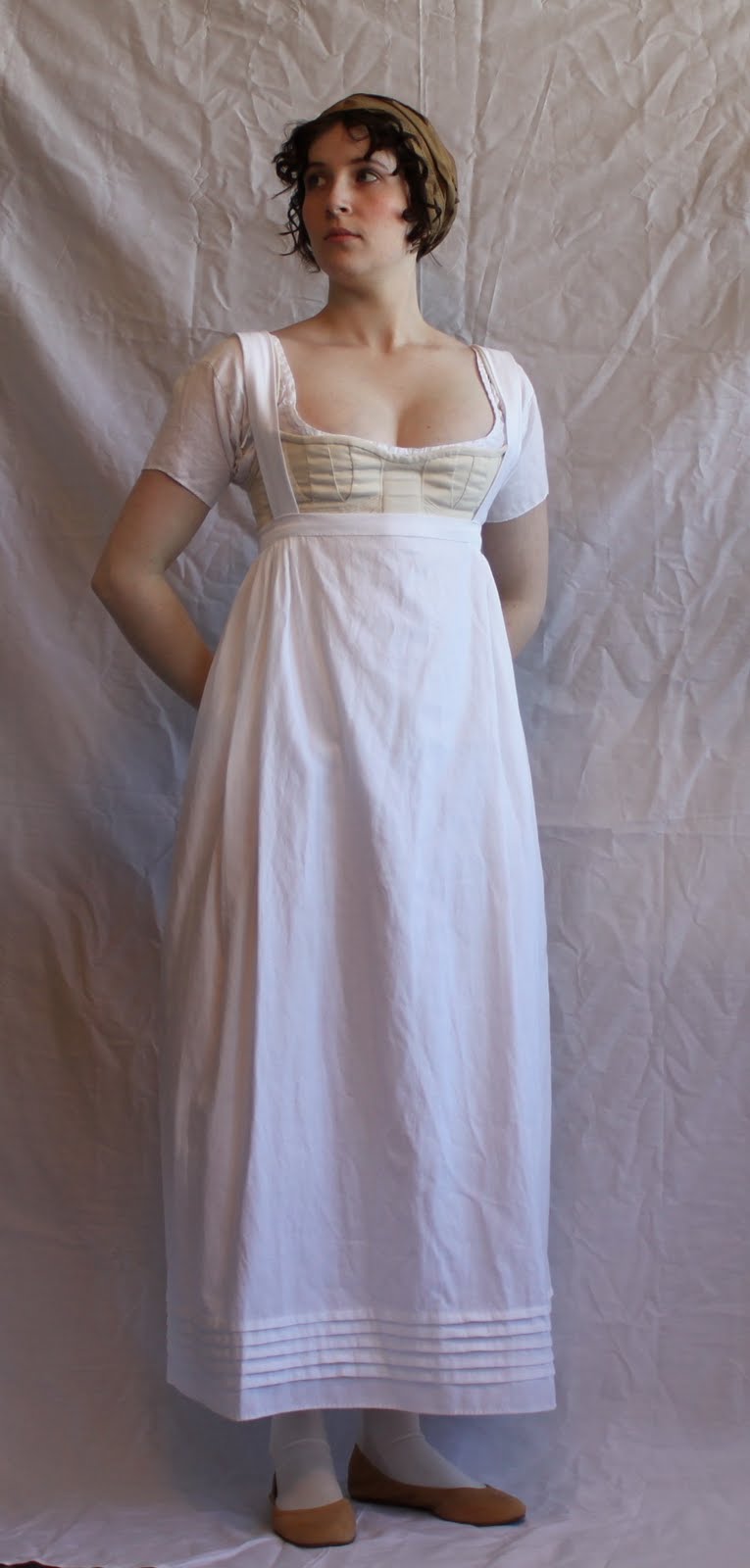
A very simply constructed garment which helps to smooth out and lift the figure under those unforgiving muslin gowns of the early 19th century.
The exterior is a mid-weight cream cotton.  The channels for the cording are back-stitched just like they are for stays.  Gussets are inserted into the bust and top-stitched around (with a spaced stitch).  The binding is of the same fabric, cut on the bias.  There are bones in the very back to keep the lacing from contracting and a removable wood busk in the front.  The embroidery is just a chain stitch.

The interior layer is linen.  The cording is inserted with a large blunt needle (tapestry).  It emerges from the channel every couple of inches, the length of one stitch essentially.  Since the cotton cord I used was fairly small, there are two lengths per channel.  You can see the slit for the busk to be inserted, raw edges just folded back.  There is a drawstring along the top of the bust, although I haven't needed it.  A higher bust line would need it to curve over.

The pattern is extremely simple, consisting of two pieces, with added gores in the bust later.  The side seams mirror each other, with plenty of seam allowance for the first fitting.  The center back curves in to snug up the figure, but the measurements are still what mine naturally are.  No reduction.  There is a 2" space accounted for in the back, since the lacings should not meet.  The pattern I designed for the cording is loosely based on a pair from the Kyoto Museum, along with a few other inspirations.  You can do as much or as little cording as you like.  While it adds thickness, and therefore some structure, it's not integral like boning in stays.  Mine are heavily corded and embroidered, but I chose to do that for visual reasons.


Friday, April 8, 2011

Below the Gown

Undergarments are often a problem in any good historical outfit.  They take as much time as a gown and are never seen.  This means that they are often forgotten and bypassed for sake of time and money.  Even when they aren't, knowing exactly what you need can be difficult.  When I was making up my muslin 1809 gown I already had a full set of undergarments for that time period.  Unfortunately they don't work!  One of the most difficult things about early 19th century is that fact that many gowns are completely see through.  I had a white shift, cream corset, and white underpetticoat.  While they work under my brown gown, I could see a huge color difference and even stitching in my corset.  The straps were also too far in on the shoulder and the back of the shift too high.

Shortly after discovering this dilemma, I received the V&A's Underwear Fashion in Detail.  In it they show a Regency era "bra".  Called a Bust Bodice circa 1800-30.  It had the right neckline, was at the edge of the shoulders, and would match with my underpetticoat.  I put it together very quickly, since it's of very simple design.  Now, it might have worked in a heavier fabric in beige.  However, the white was so vibrant underneath you could still see every seam.  Especially problematic considering the way the seams fall, and it's not exactly opaque on it's own.


My last idea was to make a new underpetticoat that had a bodice attached.  In beige.  In the end, it worked fairly well.  I'd like to adjust the fit of the bodice front if I make myself another at some point, but it's not overly visible under my gown!  There's a drawstring in the neck and under the bust.  The buttons are just covered brass rings, very flat.


Thursday, April 7, 2011

1809 Muslin Gown

I purchased some embroidered muslin a while back, knowing I was going to make a Regency evening gown with it.  But how to make it different than all the other "white" gowns?  I started going through museums looking for ideas and found this gown from the Met, dated 1809.  Line after line of tiny tucks?  Embroidered Dorset buttons?  Sounds perfect!

I adjusted the pattern from my Brown Muslin gown.  I knew the sleeves had to be longer, especially to accommodate the tucks in them.  I wish I had made the front bodice piece wider so it would drape more, but I wasn't going to go back and do all of those tucks again.  The seam under the bodice has a drawstring in it, as do the sleeve hems.

The back isn't quite small enough compared to the original, but much more and it wouldn't be comfortable on me.  I didn't grow up in stays.  I also had a shorter train.  There's still plenty to trip over, but the width of the skirt is enough that I can hold it while dancing and the hem is still to the floor.

 I made covered dorset buttons, embroidering a small motif in the center.  I used some batting inside of the bone ring to keep the back of the button from showing through.

My shoulder straps are a little wide so that I'm not showing my under-petticoat or worrying about it falling off the shoulder.  There are dorset buttons on each of the straps, I used a fake buttonhole behind it.  There's also another button center front to accent the gathered portion of the bodice.

The sleeve has diagonal tucks taken, which intersect in the middle.  I actually had to go back and re-do half a sleeve because I took too large of tucks and the visual just wasn't nearly as elegant.

As always, everything was hand-stitched.  It wasn't a difficult project until I got to the point of trying it on.  I then realized that the fabric was far too sheer to wear the undergarments I had under it (corset, etc).  I ended up making two different undergarments for it because the first one I tried was still far too visible underneath.  But, that will be a separate post.

Tuesday, April 5, 2011

Shoe Research 2

Finding fairly complete records of anything pertaining to personal goods from the 18th century is difficult enough on it's own, let alone finding a searchable database of it.  For that reason I am quite in love with the Old Bailey Records from London.  I spent some time each day for the last week searching through them and recording all the references to women's shoes.  I'd love to do the same for many other clothing items, but that's not a practical idea right now.

What's wonderful about these records is that they often mention the type of shoe, the value of it, and who it was stolen from.  Now, the convention of the goods belonging to the husband no matter who wore them makes things a bit difficult in the fact that they don't always say "Women's shoes", but often in those cases the wife does testify or the husband mentions that his wife's shoes were missing, etc.  I avoided marking down cases where it wasn't obviously a woman's shoe, but there were still 145 thefts (and one murder) from 1760-85 with usable material.  17 didn't mention the type of shoe, but listed value, and one was about 8 remnants of Callimanco that were stolen of a Shoemaker.

Out of 147 cases mentioning shoe type, I found very repetitive information.  I got quite tired of reading "Women's Stuff Shoes, value 2 s.".  The 147 cases broke down to the following (out of 188 shoes):
87 Stuff
37 Leather
27 Callimanco
17 Silk
12 Sattin
2 Damask
1 Cloth
1 Embroidered
1 Channel
1 Velvet
1 Purple and White
1 Tissue

The large majority were stolen from Widows, Spinsters, Shoemakers, and Travelers.  Not surprising considering that many Widows and Spinsters rented out rooms in their homes for income.  Most Shoemakers were robbed by workers in large scale or a not-so-crafty thief slipping a pair under their apron.  Travelers lost trunks, were accosted by bandits, or didn't guard their lodgings well.

What surprised me the most were the values assigned.  Almost all were 1-3 s. a pair.  It didn't seem to matter what they were made of.  And a great deal were new, being stolen from shops.  The most expensive pair was 10 s., stolen from a warehouse of a Coachmaster.  The cheapest was 3 d., with no specification of who it was stolen from other than name.  1 s. often showed up as value for other accessories, such as aprons or kerchiefs.  Here is a listing from Daily Life in 18th-century England showing salaries of this time period (20 shillings to a pound for my American readers).  Income didn't always reflect value, however.  Her Ladyship's pair of Sattin shoes were worth 2 s., while a Maid's Stuff pair were worth 8 s..

Black was the most common color mentioned; 4 Callimanco, 3 Sattin, 1 Leather, 1 Stuff, and 1 Silk.  There were 2 Red Moroccan Leather, 1 Green Silk, 1 Green Stuff, 1 Pink Sattin, and 1 White Sattin.  Not to mention the Purple and White pair with no mention of fabric type and a Leather pair specified to have a silk heel and straps.
What looks like a Glazed Wool or Cotton shoe from Shoe-Icons, circa 1790s.

Monday, April 4, 2011

Accessories Workshop

This weekend I attended a Burnley & Trowbridge workshop on 18th and early 19th centuries.  We focused on mitts, muffs, inked bags, and calash bonnets.
Mitts, of course, are a very important part of any woman's garment collection from both centuries.  The first chilly night and a pair of warm mitts is essential!  I personally already have six pairs of 18th century mitts (unlined & lined linens for keeping off sun and mosquitos, 2 unlined and 1 lined wool for warmth, and one fancy silk pair), so I decided to try a 19th century pair this time.  These are made from the same fabric as my English back gown, a soft camlet in a pumpkin tone.  What makes these distinctly 19th century is the longer length (they go above the elbow) and the lack of point over the fingers.  I still need to add the drawstring into mine, so they don't slide down when worn.

The muff I made 1780s shape.  The 1770s tended to be a slight rectangle (longer), the '80s were square, and by the 1800 point they became very elongated rectangles before becoming GIANT fur muffs after the turn of the century.  It's just a brown silk taffeta with silk ribbon trimming.
 The sides are gathered in by ribbons inside of channels.
 This particular muff has a separate bag so the stuffing can be recovered easily.  This means I can take an hour and make a new muff any time I like, just slipping a tube over the separate interior!  It's just made from linen stuffed with wool.

Inked bags were popular in the early 19th century.  This workshop focused on a grouping of originals found in the New England area.  Not just a local phenomenon since Jane Austen was known to have written a poem on such a bag.  They seem to have been given as friendship tokens, just like friendship bracelets today.  Very basic construction, many were two squares of cotton fabric inked and sewn together with a channeled cord on top.  The designs mimic embroidery (a perfect place to use the Ackermann designs).  The cords and tassels are just cotton crochet cord.  Mine has four sides, finishing at a point at the bottom.

Lastly is the Calash.  Mine is not finished (not surprisingly).  I chose to line mine with rose silk, since not all greens compliment my skin tone.  Many were unlined as well.  Green and Black seem to be the prevailing colors of the 18th century.  The Calash lasted well into the 19th century, still being found up to the 1860s.  The shape changed, of course.  I'm making a very tall oval style, particular to the tall wigs of the 1770s, using 40" reeds for structure.  The shape rounded out in the 1780s.  30" and 36" reed sizes were also popular, I just wanted a BIG calash this time.  Hopefully I'll make an early 19th century one later, smaller with a few other changes I can talk about then.
Examples of complete Calashes and other bonnets made by the Margaret Hunter Millinery Shop.  Mine will be the size of the black one when complete.  The olive Calash is an early 19th century style.

Friday, April 1, 2011

Satin Shoes

If you haven't heard about it then you're living under a rock.  American Duchess shoes go on pre-order today!  What makes these shoes so wonderful?  They're made from a dyeable silk satin.  Up until now the only pre-made shoes in 18th century style one could find were leather, leather, and, oh that's right, leather.  Not that leather is wrong, it's just a very small section of the picture.
I've made it a goal to do a lot of research into women's 18th century shoes, since it really does seem lacking outside of the "ooh, pretty" or general history topics.  I'm hoping to spend some time in the library next week on it, particularly on the subject of what women's shoes were made from.  We know the very poor were given black leather shoes from the church.  We see plenty of poor women in art wearing black shoes (whether they are leather or a cloth isn't determinable).  But, it may be less of a representation of what actually was than either an easy way to paint shoes, or more likely a stereotype of being poor that easily communicates in that one panel image the status of that woman.  One of the first things I did in searching for commonality of materials was to peruse the Virginia Gazettes from the later half of the 18th century (mostly 1769-1779) and take a tally of all the references to shoes for sale.  Here's what I found:

Out of 25 advertisements for shoes:
13 Calimanco
12 Satin
10 Leather
9 Silk
7 Stuff
3 Moroccan Leather
2 Embroidered
1 Cloth
1 Braided
1 White Kid

There was a common mention of specifically Queen's Satin or Silk shoes (4 times) and 4 mentions of Didsbury shoes as well (some silk, some leather).  Those are both particularly renowned locations for shoe manufacturing.  One reference to leather specified Calf and Red, one Moroccan reference specified Red as well.  Calimanco had a reference to black and to green.

I also came across three runaway ads for female servants, two of which were Irish.  Two had on black Calimanco shoes, the other had on Light Blue Calimanco shoes.

I know this is only a start and not at all applicable to who exactly wore what.  It could be argued that the more fashionable shoes would be advertised, but then I would think there would be a smaller number of leather shoes listed.  And it's not like there's any where else to shop.  If you're poor you might be given shoes.  Or economical, you'll shop at second hand shops.  There was actually a separate trade, between a Shoemaker and a Cobbler, called a Translator.  They took old shoes, saved the good bits, and remade them into "new" shoes.  Second hand you'll be buying what the fashionable left behind.
While Calimanco shoes are near impossible to find, at least we now have a good source for the second most commonly advertised shoe on my list; Satin!  But, I do know of a source for Calimanco now, be it ever so expensive.  And give me a couple years of patience, there might just be a source for them yet!!
Red Satin shoes from Shoe Icons